
See what a Notified Body review will find — before you submit.
A structured regulatory assessment of your medical device technical file under EU MDR 2017/745. Finding-level results with full regulatory traceability, delivered in hours, not months.
Why technical files still fail at review
Most pre-submission reviews check whether a section exists, not whether it actually addresses what the regulation requires. A risk management file is present, but does it cover every hazard relevant to this device type, contact duration, and intended patient population? Checklists don't answer that.
Pre-submission reviews almost always work section by section. The clinical evaluation is reviewed on its own. Risk management on its own. Verification and validation on its own. But a Notified Body reviewer reads across sections — a residual risk accepted in the risk report but not addressed in the clinical evaluation, a claimed shelf life unsupported by the aging validation. These are findings that only surface when someone reads the full file as one connected assessment. Most teams never do that before submission.
When a technical file reaches the Notified Body with gaps that the manufacturer's own review did not catch, the result is predictable. Queries are raised. Responses are drafted. Follow-up queries arrive. Months pass. The review cycle is long not because the process is inefficient, but because the file was never properly assessed before it was submitted.
Structured assessment, before the real one
Most regulatory tools are built to help manufacturers prepare documentation. ReGentra was built to assess it.
The assessment logic, the question structure, the evaluation sequence, the cross-document consistency checks — all of it was designed from the perspective of someone who reviews technical files for a living, not someone who writes them. The system doesn't check whether your file looks complete. It tests whether your file holds up under structured regulatory scrutiny.
How the assessment works
A populated question list with a verdict on every question.
An audit summary with scope definition, document coverage, and finding counts.
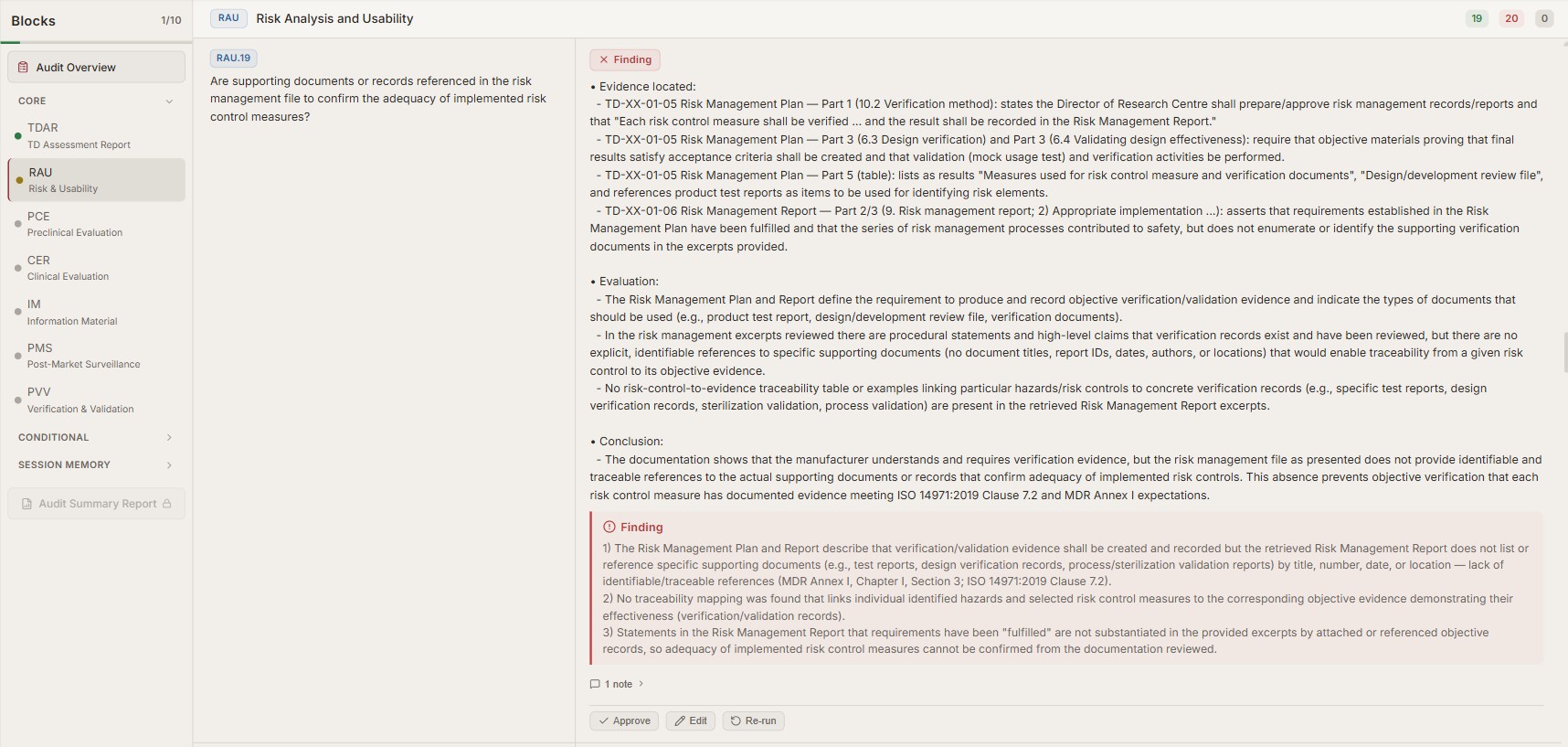
A findings report with each finding mapped to its regulatory reference and source location.
Built to be verified, not believed
Closed evidence boundary
The system works only with uploaded documents and a verified standards database. It cannot reference external knowledge or generate unsupported claims.
Human approval at every step
Every output remains a draft until a reviewer confirms it. The system cannot approve its own work.
Full traceability
Every finding is mapped to a specific regulatory requirement. Every claim carries its source reference. A finding without a traceable origin is a system error.
Post-generation verification
After every output, the system checks whether any reference was generated that does not exist in the evidence base. Detected leakage is flagged for the reviewer.
No model training on your data
Your documents are never used to train models. Assessment data is processed, delivered, and isolated. Nothing leaves your tenant boundary.
EU-hosted, encrypted, yours to delete
All data is hosted in the European Union, encrypted at rest and in transit, with strict tenant isolation. You control your data lifecycle — all documents can be deleted on request, and no assessment data is retained beyond your active engagement.
See it on your own technical file
Leave your details and we'll reach out to discuss how ReGentra applies to your technical documentation.